The Rise of Passive Investing: What It Means for Asset Management Companies

- Introduction
- What Is Passive Investing and Why Is It Growing in India?
- Why Are Investors Shifting to Passive Investing?
- How Do Active Funds Compare to Passive Index Funds?
- Are Passive Funds Delivering Better Returns Than Active Funds?
- How Is the Rise of Passive Investing Affecting AMCs in India?
- Will Passive Investing Replace Active Investing?
- Conclusion: What’s the future of passive investing in India?
Introduction
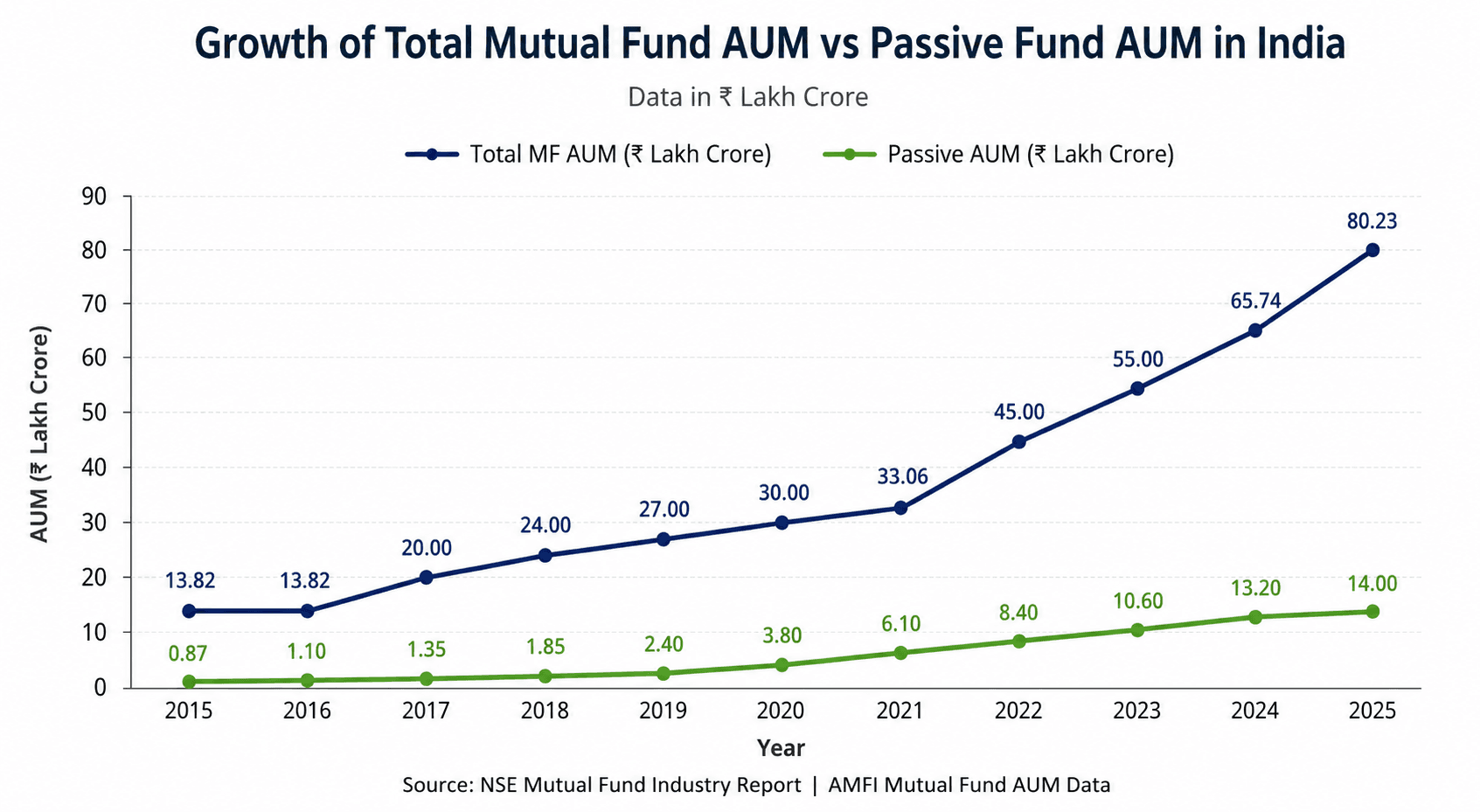
Passive funds in India now manage over ₹15 lakh crore in assets (up from ₹6.6 lakh crore) just three years ago. Also, recently, their share of total mutual fund AUM has grown from 3% in FY17 to approximately 17% by early 2026.
With this shift, every Asset Management Company in India is rethinking from active investing to passive investing.
But, “What is Passive Investing and why this sudden shift?”
Keep reading to understand what passive investing is, why investors are shifting, how passive funds compare to active funds on returns, and how AMCs are responding.
What Is Passive Investing and Why Is It Growing in India?
Passive investing is a strategy where a fund tracks a market index (like Nifty 50 or Sensex) instead of trying to beat it. It holds the same stocks in the same proportion(ratio) as the index, with no active stock picking, at significantly lower cost.
In short, passive investing means the fund manager decides to follow the footsteps of an already existing market index, rather than researching and picking stocks for the portfolio.
In India, two products drive passive investing.
- Index funds (bought/sold like regular mutual funds at end-of-day NAV)
- ETFs (traded on stock exchanges during market hours like stocks).
Why Are Investors Shifting to Passive Investing?
Investors are shifting to passive funds for three reasons: most active large-cap funds consistently fail to beat their benchmarks, passive funds cost a fraction of active funds, and growing financial literacy has made investors more cost-conscious.
Lower Cost & Expenses
Passive funds have lower expense ratios because they simply track an index rather than actively selecting stocks. Lower costs can improve net returns over the long term.
Simplicity & Diversification
A single passive fund provides exposure to multiple stocks and sectors, making diversification simple and reducing company-specific risk.
Emotion Management
Passive investing follows a rules-based approach, reducing emotional decisions such as panic selling or frequent portfolio changes.
Underperformance of Active Managers
Many active funds struggle to consistently outperform their benchmark after fees and expenses. Passive funds aim to match market returns at a lower cost.
How Do Active Funds Compare to Passive Index Funds?
One clear distinction (or difference) between active funds and passive funds is the fund manager’s involvement.
In an active fund, the fund manager constantly researches and tracks markets to generate alpha. Comparatively, in a passive fund, the portfolio follows index movements.
| Active Funds | Passive Index Funds | |
| Objective | Beat the benchmark | Match the benchmark |
| Expense ratio | 1–2% | 0.02–0.5% |
| Manager dependency | High returns depend on one manager's skill | None – rules-based, tracks index |
| Typical holdings | 30–60 stocks, manager's picks | All index constituents, same weight |
| Large-cap underperformance | Nearly 66% fail to beat benchmarks (SPIVA 2025) | Matches benchmark by design. |
| Where active still wins | Mid-cap, small-cap, niche strategies | Large-cap, broad market exposure |
Are Passive Funds Delivering Better Returns Than Active Funds?
Historically, passive funds have outperformed primarily due to lower fees and consistent tracking of benchmarks. However, this advantage can vary across market segments, economic cycles, and investment horizons.
In a report, Morningstar analyzed nearly 9,204 mutual funds and ETFs and found out that only 33% of active strategies survived and beat their asset-weighted passive funds over the previous 12 months.
How Is the Rise of Passive Investing Affecting AMCs in India?
The growth of passive investing is on a steady graph due to shrinking AMC fee income, forcing them to innovate products. Also, this upward curve in passive funds is a shift in the competitive battleground from fund manager reputation to cost efficiency and index coverage.
Lower Revenue per Investor Rupee
An active large-cap fund charging 1.5% on ₹10,000 crore AUM can earn about ₹150 crore in fees. A passive fund, on the same side, charging 0.1% on the same AUM, earns only ₹10 crore. As more investors shift to passive funds, AMCs earn less revenue for every rupee they manage.
More Passive Fund Launches
To attract investors, AMCs are launching a wide range of index funds and ETFs. This list includes not just Nifty 50 funds, but also Nifty Next 50, Midcap, sectoral, thematic, factor-based, and international index funds. The goal is to offer investors more passive investment choices.
In 2026, around 5 crore folios have invested in index funds or ETF,s and 701 are passive funds in India (as per NSE).
Pressure on Active Fund Fees
With passive funds gaining popularity, active funds face increasing competition. To stay attractive, some AMCs are reducing expense ratios, while others are launching "enhanced index" funds that combine index tracking with limited active management.
Will Passive Investing Replace Active Investing?
No. Passive investing is growing rapidly, but it is unlikely to fully replace active management.
The more likely outcome is a core-satellite model becoming the Indian standard: passive index funds for 60–70% of the portfolio (the "core"), and active funds or SIFs for 30–40% in segments where active management adds value (the "satellite").
This core-satellite model is also visible in Structured products and MLDs.
(Note: This percentage of the model can vary depending on the product.)
Conclusion: What’s the future of passive investing in India?
Both active and passive funds have a role to play in an investor's portfolio. As awareness, digital access, and cost-conscious investing grow, passive funds may continue to gain market share in India.
A useful way to think about it is that passive funds are the better default for broad market exposure, while active funds are a more selective bet where category-specific skill can matter.
Rather than choosing one over the other, many investors may benefit from using both. However, it is important to do your research or consult a mutual fund professional before investing.
Frequently Asked Questions
What is passive investing?
Passive investing is a strategy where a fund tracks a market index (like Nifty 50) instead of trying to beat it. The passive fund holds the same stocks in the same proportions as the index. The only advantage is that it costs significantly less than active management because no stock picking is involved.
Are passive funds better than active funds?
How much do passive funds cost compared to active funds?
How big is the passive fund market in India?
What are the risks of passive investing?
How is the rise of passive investing affecting AMCs?
Disclaimer:
The information provided in this article is for educational and informational purposes only. Any financial figures, calculations, or projections shared are solely intended to illustrate concepts and should not be construed as investment advice. All scenarios mentioned are hypothetical and are used only for explanatory purposes. The content is based on information obtained from credible and publicly available sources. We do not guarantee the completeness, accuracy, or reliability of the data presented. Any references to the performance of indices, stocks, or financial products are purely illustrative and do not represent actual or future results. Actual investor experience may vary. Investors are advised to carefully read the scheme/product offering information document before making any decisions. Readers are advised to consult with a certified financial advisor before making any investment decisions. Neither the author nor the publishing entity shall be held responsible for any loss or liability arising from the use of this information.
Related articles: